
How the study activity model can be used to strengthen study groups
The study activity model highlights that learning takes place in many different contexts, not only in the classroom. In this article, we explain how the model can be used to strengthen students’ work in study groups, both as a visual tool and as support for designing teaching that covers all aspects of learning.

The study activity model provides an overview of the different types of study activities that students are expected to engage in as part of their degree programme. The model can serve as a useful tool in course planning, helping to distribute students’ workload realistically. At the same time, it can be used to illustrate to students how significant a part of their overall effort their study group work actually is.
The study activity model has been developed primarily to help students see how different types of activities all contribute to their overall effort in their studies, with a focus on taking responsibility for their own learning. In this way, they become aware that learning does not only take place in the classroom, but also when they prepare or work in study groups,” explains Helle Meibom Færgemann, special consultant at the CED.
Four categories show where learning takes place
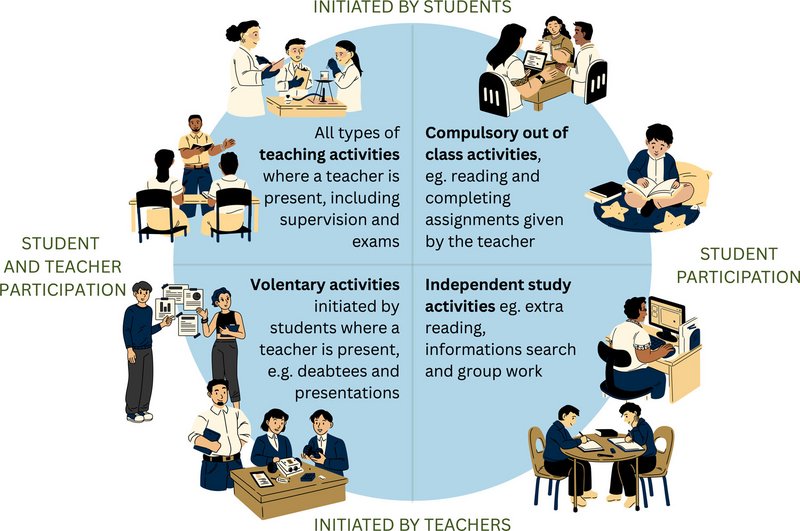
The study activity model is divided into four categories and distinguishes between the different roles that the teacher and the students have in the four types of study activities.
- In category 1, the teacher is the one who frames the activity and is also present while the students carry it out. This category includes traditional small class teaching, lectures, laboratory teaching, and clinical teaching.
- Category 2 often follows category 1 activities and includes study activities designed by the teacher, but where the teacher does not necessarily need to be present while the activities are carried out. These can include assignments that students have been asked to prepare (for example, a student presentation), project and group work, or online learning activities.
- Category 3 includes study activities for which the students themselves are primarily responsible, and in which the teacher does not take part. However, the teacher may share responsibility for aspects such as prior scaffolding or subsequent follow-up. These activities include various forms of self-study initiated by the student, collaboration with fellow students, and exam preparation. The activity is driven by the students’ own learning needs.
- Category 4 in the study activity model consists of activities initiated and framed by the students themselves, but in which the teacher also takes part. Examples include peer feedback or supervision initiated by the student, as well as student-organised seminars, workshops, debates, or study groups.
”Traditionally, students have often regarded contact hours as the place where learning happens. The study activity model can be used to show students that they actually learn just as much – perhaps even more – when they take an active role and share responsibility for their own learning,” explains Helle Meibom Færgemann.
She points out that it is about raising students’ awareness that learning does not only take place in category 1, but also in categories 2, 3, and 4, where the teacher frames the activities and the students gradually take on more responsibility themselves.
How study groups can be activated in all four categories
Traditionally, study groups have mainly had their place in category 3, but in fact, they can be activated in all four categories.
”Much of the traditional use of study groups falls primarily within category 3. This means that students themselves must decide what they actually want to use their study groups for, which parts of the syllabus they would like to discuss together, and so on,” explains Helle Meibom Færgemann.
She emphasises that students can derive even more from their learning if their collaboration is also facilitated in the other categories, for example, in category 2 by giving them more specific assignments, projects, or presentations to work on together.
At the same time, it can strengthen the dynamics within the group if they are activated in the contact hours – that is, category 1 – from the beginning of the semester. This creates a natural link between the activities that take place during contact hours and those that the students organise themselves outside of class. In this way, it increases the chances of genuinely meaningful learning taking place in category 3, where the students take ownership of their learning.
”For example, it can be beneficial to spend time during small class teaching helping the study groups establish some ground rules for their collaboration: When do we meet? Do we take minutes? Where do we store our materials? What do we do if someone cancels?” explains Helle Meibom Færgemann.
In some degree programmes, students use study group contracts. Teachers can also refer their students to AU Studypedia, where they can find for mutual alignment of expectations in the form of five points that can be used for a group agreement. These address aspects such as agreeing on expectations, setting clear guidelines regarding lack of preparation, participation, or adherence to agreements, meeting frequency, keeping a logbook, and evaluating the collaboration:
“It can be helpful for students if the teacher schedules regular dates for the groups to evaluate themselves. Is the collaboration still working? Does anyone want to change groups? Or might it simply be a valuable learning experience to try working with others? It does not have to involve conflict. On the contrary, it can be a way for students to develop,” explains Helle Meibom Færgemann and continues:
”Naturally, how much energy you put into facilitating study group collaboration depends on how long the groups are intended to exist and how significant a role they are meant to play. However, it sends a strong signal when the teacher demonstrates that the study groups are taken seriously.”
One way to activate students in category 4 is through peer feedback sessions, with the teacher acting as an observer. By giving feedback to others, students improve their ability to understand and apply criteria for assessing both others’ and their own performance. On AU Studypedia, students can learn how to give feedback in their collaboration, and on AU Educate, teachers can find inspiration for how to facilitate peer feedback.
Study groups should be integrated into the entire curriculum
Helle Meibom Færgemann sees a clear tendency for teachers to focus increasingly on facilitating study group work. At the same time, she emphasises the importance of scaffolding to a degree that matches the students’ level of experience.
“In the first semester, teachers often strongly focus on forming study groups and giving them concrete tasks. However, in the later semesters, this focus sometimes decreases. In several cases, we have heard that this leads to the study groups gradually dissolving,” she explains.
Therefore, she hopes that, inspired by the study activity model, teachers will develop a more intentional and strategic use of study groups and integrate them more closely into their teaching.
”There is also another point to be aware of: many students take a break after completing their bachelor’s degree before starting their master’s, or they transfer to a new programme. These students may be experienced, but they might have forgotten how to make use of a study group. At the same time, they may also need support in forming new groups. Therefore, it may be necessary to restart the work with study groups in the first semester of the master’s programme.”
She points out that activating students in category 4 can be particularly meaningful at this stage, as they are more mature, have more experience, and have begun to orient themselves towards different career paths. Here, teachers can support them in forming self-organised study groups that align with the directions they wish to pursue after completing their studies.
In addition, Helle Meibom Færgemann encourages teachers to coordinate the facilitation of students’ group work with their colleagues:
”It is important to coordinate study group work with your colleagues to understand how students are working in groups across the year. It is fine if study groups are used in the same way, and it is equally fine if they are used differently. What matters is that the students are aware that in one course, groups are used in a particular way, while in another course, they are used differently,” she emphasises.
She elaborates that there is no need to micromanage the use of study groups across courses. However, there can be value in having a shared approach during the first semesters. In the first and second semesters, it can be beneficial to work very explicitly with how the study groups are to be used and to ensure clear facilitation, possibly with dedicated time allocated during small class teaching.
At the same time, it is important that the groups are not suddenly left entirely on their own in the third semester. Instead, there should be a gradual transition towards greater autonomy, allowing the students to take on increased responsibility and independence in their collaboration:
“We sometimes hear that study groups in the third semester can be challenging for students. Suddenly, they are expected to figure out everything on their own. Some may feel obliged to meet but are unsure what their meetings should focus on. And in addition, some stop participating in study group work altogether,” she concludes.
Further reading
You can read more about the study activity model on AU Educate. Students can also explore the model themselves on AU Studypedia.
You can also find information about study groups as a general pedagogical topic on AU Educate.
If you are looking for inspiration from other teachers, you can delve into this comprehensive 2023 report, which examines the study group landscape at Aarhus University.