This report has been made in response to requests from several departments for insights into other departments’ experiences with study groups. We aim to meet that need in this report. Based on interviews with teachers from various departments, the report provides brief descriptions of examples of vastly different approaches to working with study groups.
Drawing from these examples and relevant studies, the report offers suggestions for questions that might contribute to clarifications across different degree programmes. The CED is, of course, happy to assist with consultation services, presentations, or workshops.
Thank you to all the colleagues at Aarhus University who kindly participated in interviews. Special thanks also to Tina Bering Keiding, as well as Simon Raaby Holmgaard Poulsen and Helle Meibom Færgemann from the CED for their thorough review and constructive
This is a report on study groups. It is aimed at colleagues at Aarhus University (AU) with the purpose of providing ideas on how to support the departments’ work with study groups. The report was prepared in response to requests from several departments at AU for assistance on this topic.
There is no definitive answer as to how to create the best conditions for study groups. Research in this area addresses various individual aspects of study groups, providing a very fragmented picture. Therefore, this report is not a research review but a research-informed report on certain factors that influence the work with study groups and are thus worth considering. Among other sources, the report is inspired by a series of interviews with teachers at AU on the use of study groups. While it does not provide a comprehensive overview of all practices at AU regarding study groups, it offers insight into a wide range of practices. All faculties are represented by 2-3 programmes.
The report is structured around six factors: objectives, content, framework, assessment, learning processes, and learning prerequisites. These were selected partly because they are considered essential elements in learning situations (Hiim and Hippe, 2016), and partly because the interviews at AU reveal variations in relation to these six specific factors. The factors cannot be separated from one another. Decisions concerning one factor will influence the others.
To enable an investigative and analytical approach to the use of study groups, the factors are described separately in this report. However, decisions (or lack thereof) regarding one factor will influence the other factors. For example, deciding what the groups should work on will affect how it makes sense to form the groups, what learning processes will take place within the groups, etc. It is important to maintain this holistic perspective on study groups. However, to better understand and address the factors that make up the whole, we use a division into six factors here.
The description of each factor is based partly on examples from AU and partly, where possible, on research related to the specific aspect of study group work. Based on this, some questions are proposed for departments to consider, and for consultants to reflect on as well.
Following the report’s initial section, which discusses why study groups are important, six sections follow, addressing each of the six factors. Finally, there is a section on typical challenges faced by study groups.
The concept of study groups can encompass a wide variety of group types. Here, we use the term, in line with Danmarks Evalueringsinstitut (Danish Evaluation Institute), as a collective term for groups where students meet outside of class to work with academic material (EVA, 2022: 5).
At Danish universities, an average of 85% of students participate in a group (EVA, 2022: 8). However, there are some variations depending on the size of the degree programmes. In smaller programmes with fewer than 60 students enrolled per year, the figure is 89%. In larger programmes with over 120 students enrolled per year, group work accounts for slightly less, at 83% (ibid.: 20).
The figures are presented in the report Gruppearbejde på de videregående uddannelser: Førsteårsstuderendes oplevelser og erfaringer (Group work in higher education: First-year students’ experiences and perspectives). The report is based on extensive quantitative empirical research1, which examines the scope and practices related to various aspects of the use of study groups in a Danish context. It highlights that group work plays a significant role, both socially and academically, in Danish higher education (EVA, 2022: 6).
In terms of social connections, the report shows that 70% of all students experience a sense of belonging to their study group to a very high or high degree, while the sense of belonging to their programme and class is slightly lower, at 61% and 60%, respectively. The sense of belonging to the year group drops to 37% (ibid.: 35). University students, in particular, experience a strong sense of belonging to their study group. Across university programmes of varying sizes, 72–74% report a very strong sense of belonging to their study group. The study also shows that mutual support within the groups is primarily academic in nature (ibid.: 37).
The same trend is evident in the report Navigating in Higher Education (Thingholm et al., 2016), which is based on empirical data from AU. Here, 87% report participating in study group work (ibid.: 38).
In addition to the significant role study groups play in students’ academic lives, the EVA report also highlights their substantial potential in enhancing both academic learning outcomes and social belonging within the programme. The report references international research (Pintrich, 2003; Fredricks et al., 2004; Zepke & Leach, 2010) demonstrating that collaboration with fellow students is essential for well-being, learning outcomes, and programme completion. Additionally, the report references research (Millis, B. J., 2014; Davidson, N., & Major, C. H., 2014; Johnson, D. W., Johnson, R. T., & Smith, K. A., 2014) that specifically highlights how group work can support students’ active and understanding-oriented learning strategies, as well as promote social well-being.
In short, group work plays a significant role in learning and fostering a sense of belonging in the programme (EVA, 2022). However, the EVA report provides little insight into how these potentials are realised. The research does not offer definitive answers either, but it does highlight several key factors that are important for the functioning of study groups.

At AU, there are several variations of study groups. In a poll conducted by the CED at AU, variations emerged that can largely be described based on the six factors outlined in Hiim and Hippe’s didaktiske relationsmodel (the didactic relationship model) (Hiim and Hippe, 2007):
But how are these six factors manifested at AU? And can pedagogical/didactic research on study groups highlight what is particularly important when focusing specifically on these factors? We aim to address this by describing examples of practices from the interviews we have conducted and by pointing to studies related to the field. Based on this, we have formulated questions to support reflections and decisions regarding study groups within each of the six factors.
In some programmes at AU, study groups are primarily seen as a means to ensure a sense of social belonging within the programme – whether to the study group, the year group, or the entire programme as a whole.
However, while a sense of social belonging is important for reducing dropout rates, several studies indicate that social well-being is closely linked to academic well-being (see, for example, Isohätälä et al. 2020; Le et al. 2017; Järvenoja et al. 2015; Malmberg et al., 2015; EVA, 2022). Therefore, it is relevant to consider which disciplinary assignments and learning outcomes the study groups should focus on if the aim is to enhance the students’ social well-being and sense of belonging to their programme.
Other studies (see, for example, Le et al., 2018; Meijer et al., 2020; Järvenoja et al., 2015) indicate that students need to learn how to collaborate. Engaging in academic collaboration requires skills such as being able to accept others’ viewpoints, providing detailed explanations, giving and receiving help, and negotiating (Le et al., 2026: 104). If students lack these skills, they require teaching in collaboration and communication (Meijer et al., 2020: 1234).
Another researcher emphasises that what is essential in collaborative situations is not only solving an assignment together, but also learning how to approach such assignments most effectively in the future, whether independently or with others. Furthermore, what matters is also being able to do so based on a deeper understanding of the disciplinary field:
[...] in collaborative learning situations, what is at stake is not only to solve the problem together, but also to learn how to solve such problems more efficiently in the future, either together or alone, and to be able to do so in virtue of deeper conceptual understanding in the problem domain. (Baker, 2015: 468)
In other programmes at AU, the development of collaboration skills is an explicit learning outcome. In such cases, it would be beneficial not only to teach these skills but also to make them subjects of either formative or summative assessment. This approach creates alignment between what is assessed and what students are learning (Meijer et al., 2020).
Example 1
In this programme, they are redefining study groups. Previously, the primary goal was to foster well-being and a sense of social belonging in the programme, while the learning outcomes were more implicit. Among other things, the groups are essential for the students’ oral skills, as the programme is predominantly focused on written abilities. Since all exams are written, it is within the study groups that the students engage in oral and discussion-based learning and develop their subject-specific oral vocabulary.
However, the students face challenges due to an extensive syllabus, making it difficult to prioritise study group work. This created issues within groups that were primarily socially driven. In groups where the members did not interact well socially, they lacked a reason to meet and felt the group had no purpose.
As a result, it was decided that students would be provided with weekly assignment prepared by the teaching staff giving the lectures. This way, the study groups have a concrete purpose to work together. However, it has not been entirely easy for the teaching staff to design assignments with sufficiently relevant or precise tasks, so the format is still in development. The ambition is to create better alignment between the teaching led by student instructors, the weekly assignments, lectures, and exams.
The student instructors oversee communication with the study groups. The teachers deliver lectures, while the small class teaching during the first year is handled exclusively by the student instructors.
Example 2
In this programme, the employer panel has expressed a desire for graduates who are better equipped to work in teams and have strong collaboration skills. Therefore, an explicit learning outcome for the study groups in the master’s degree programme is for the students to develop an understanding of group processes.
The programme distinguishes between reading groups and exam groups. At the beginning of the semester, reading groups consisting of 5–6 members are formed. These groups a put together based on questions designed to reveal each individual’s preferred working style, heavily inspired by the Belbin test (see appendix 1 for more details). Midway through the semester, exam groups are established according to which exam theme each student chooses to pursue.
These groups consist of 3-6 students. After this, it is optional whether students choose to continue in their reading groups. The collaboration within these groups is included as part of the course evaluation.
Regarding the purpose of study groups, consider the following questions:
|
The second significant factor regarding study groups concerns the content of the groups’ work. Our interviews revealed that in some programmes, study groups are primarily expected to read and discuss the syllabus, in some cases supported by teaching by student teachers between lectures. In such cases, the academic content of the group’s work does not foster a sense of accountability among members. In other programmes, the groups are required to produce a shared product in the form of a project or a semester assignment and attend the exams together. In such cases, the group members are held highly accountable to one another.
Thus, the content of the study group’s work significantly influences group dynamics. Content that encourages the group to work towards a common goal often results in a stronger sense of commitment among members, requiring them to function as a team (Mac and Hagedorn-Rasmussen, eds., 2013). Conversely, content such as minor assignments or reading of the syllabus might result in less committed group collaboration. The less accountable group members feel to one another, the less significance the study group will have for the individual’s studies, and the less effort they are likely to invest in making the group function well. Academic collaboration may become secondary to personal preferences and shared interests outside of their studies.
Hence, the relationship between the study group’s work and the rest of the teaching is important. Below, we have examples ranging from cases where the study group’s work is not integrated into the teaching at all, to cases where almost all preparation for the teaching takes place within the group. Additionally, there are examples of assignments designed in such a way that each group member is required to complete their part of the assignment independently, thereby eliminating the need for collaboration on the academic content.
Example 3
In this programme, the work of the groups is integrated into the teaching, typically by having students prepare something to be presented or explained. Most of the time, the groups meet in person, as the assignments require face-to-face interaction. However, when required to submit written assignments, they typically use Google Docs.
Example 4
In this programme, the work of the study groups constitutes an essential part of the preparation for the teaching, and the teachers emphasise incorporating the groups’ work during class meetings.
Example 5
In this programme, the study groups are required to produce a semester project, which the group collectively presents at their exam. Additionally, as part of the semester project, the students must write a half-page reflection on the collaboration of the group and their own experience of working in the group. Thus, the group members are accountable for both the academic content and the collaborative process. The groups are formed based on personality tests (Insights.com) as well as other criteria such as gender, age, digital competences, etc. The groups are mandatory and remain the same for an entire semester, but the criteria for group composition change from semester to semester. It is up to the groups themselves to decide whether they also want to use the groups for preparation for teaching.
Example 6
In this programme, it is mandatory for the study groups to work together during teaching, but it is optional for the students to use the groups outside of class.
Example 7
In this programme, semester projects must be submitted as a group, but it is up to the students to decide whether they want to use the groups for preparation for the classes. Yet, the programme coordinator estimates that most students use their semester groups or parts of them for collaboration beyond the semester project.
Example 8
After students had repeatedly expressed, in several evaluations of the study onboarding process and during multiple semester meetings with student counsellors, that the establishment and facilitation of study groups consistently caused significant "disruption" in their degree programmes, the Board of Studies at the Danish School of Education decided to develop a minimum template (see appendix 2) for describing study groups within a programme. In continuation of this, the Board of Studies have asked to all degree programme boards to take a position on and document how the work of study groups should be facilitated within each programme and across specific modules/semesters. The study group policy paper is made available on Brightspace for students. This does not imply that study groups are to be organised or utilised uniformly; rather, it ensures that the degree programme boards address a set of questions. For example, in some programmes, students may prefer to organise their study group work independently and avoid having the teachers spend time on study groups, while in other programmes, the work of study groups is an integral element of the small class teaching.
Regarding the content of study group work, consider the following questions:
|
The third factor concerns the framework within which the groups operate. At AU, there are significant differences in the frameworks set for study groups, how these frameworks are established, and who sets them. In some programmes, it is up to the students to establish their study groups and determine how they will use them and for what purpose. In other programmes, there is strict regulation regarding the formation of the groups, their working methods, and the content of their work. It also varies whether participation in study groups is mandatory – this is often related to whether the groups have obligations related to exams.
Framework conditions is a broad concept, but there appear to be at least two key factors influencing the work of the study groups:
In general, study groups are introduced early in the first semester, but there are significant differences in how this is done. In many programmes, mentors are responsible for explaining what a study group is, how it can be used, and how the work within the groups will look like moving forward. This is sometimes supported by explanatory documents and occasionally assignments that the study group must solve or discuss. In other instances, study groups are required to complete collaboration agreements or align expectations.
The way new students are introduced to study groups sends the first signals about the programme’s expectations for the groups’ work and their importance within the study.
Example 9
In this programme, a series of documents are provided that outline the framework for the groups’ work. Additionally, the study groups are given assignments to help them to concretise how they will work within these frameworks. Lean more on AU Educate: Testing study groups during the students’ first semester.
The documents that the students work with, available only in Danish, are:
Example 10
In this programme, students receive materials they can use in their study group, but it is up to the groups themselves how they choose to use them. A discussion forum is set up in Brightspace, where students can share experiences. Lean more here: Testing study group compositions
Regarding the introduction to study groups, consider the following questions:
|
There is significant variation in how study groups are formed. Some programmes use tests inspired by, for example, Belbin (Belbin.com) or Insights (Insights.com). The original versions of these tests are quite expensive and require that those administering them be authorised to do so. However, they can be adapted and used in simplified versions (Mac and Hagedorn-Rasmussen, 2013).
Other programmes design questionnaires that allows groups to be formed based on self-selected criteria. For example, UniHelper’s questionnaires (UniHelper.dk), can be used, with the option to add customised questions. Alternatively, some programmes from study groups randomly or leave the tutors to form the groups.
Smaller programmes often prioritise fostering a sense of belonging to the entire year group. As a result, students are placed in several different randomly composed groups during the first nine weeks. This approach not only helps students get to know many of their peers but also provides an opportunity to reflect on their own collaboration style as they experience different group configurations.
What do we recommend? Here are some research-based insights:
Belbin’s test is not a personality test. Belbin’s theory focuses on the roles that group members assume based on their actual behaviour. The theory is based on the idea that a well-functioning team requires nine different roles. Three roles are related to thinking (Plant, Monitor Evaluator, and Specialist). Three other roles are related to tasks (Shaper, Implementer, and Completer Finisher). The last three roles are social (Resource Investigator, Teamworker, and Co-ordinator). There are no roles that are inherently wrong or bad – all are important. One person can easily assume multiple roles – and assume different roles in another group composition. Therefore, Belbin’s role theory can be used to enhance understanding of how the group functions and how each individual contributes. Such a conversation might, for example, lead to the realisation that the group has a surplus of thinkers but lacks task-oriented members. Based on this insight, the group might decide to take steps to stimulate more action (read more in appendix 1).
Example 11
In this programme, students are placed in three different groups during the first nine weeks of their first semester. The final group is formed based on a questionnaire that asks about students’ expectations regarding: Meeting frequency, social/academic purpose, experiences and concerns, and any preferences for specific individuals they would like to work with. However, students who like working together often gravitate towards one another in the end, making it challenging to maintain the composition of the official groups.
Example 12
In this programme, the teacher of the course forms the groups. There are four courses in the first semester, and for each of these, the teachers require a unique group composition. As a result, each student is part of several different study groups. In one course, the groups are formed based on a questionnaire designed to uncover the students’ fears, expectations, and relevant academic experience. The goal is to distribute engagement and experience evenly among the groups. Active participation in the teaching is required to pass the course, making well-functioning groups essential. There are always students who do not complete the questionnaire, and there are typically a few groups that do not function very well. Additionally, some students withdraw from the programme during the semester, leading to smaller groups over time. Participation in the groups is mandatory because they work on study projects together. In the final course evaluation, there are always some students who appreciate that the teacher organises the groups. However, those who end up in less effective groups often express a preference for self-selected groups. Yet, self-selection can lead to some students not being chosen, which can feel excluding and demotivating.
Example 13
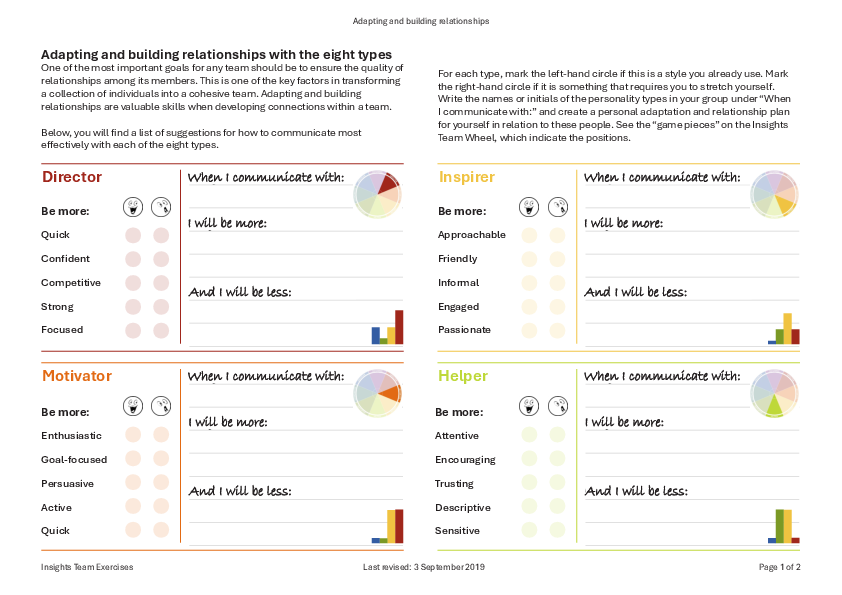
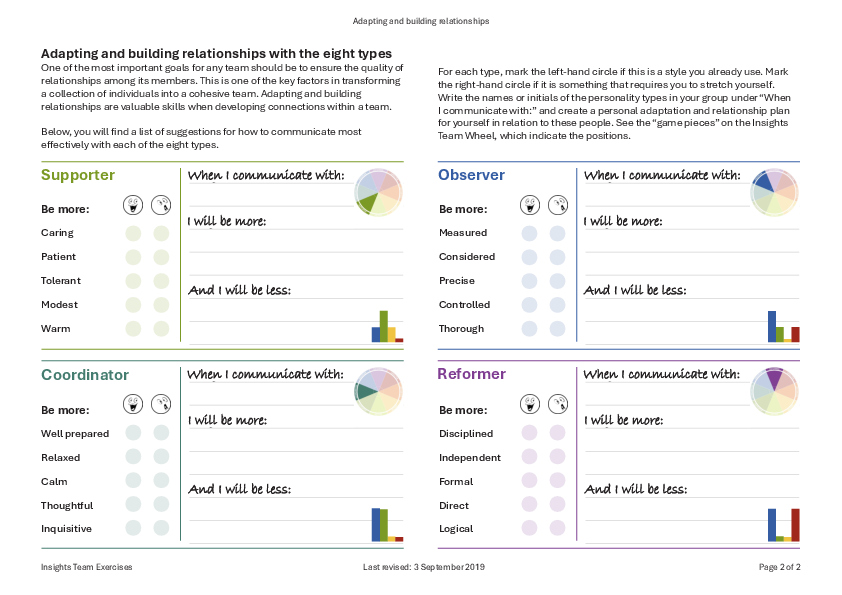
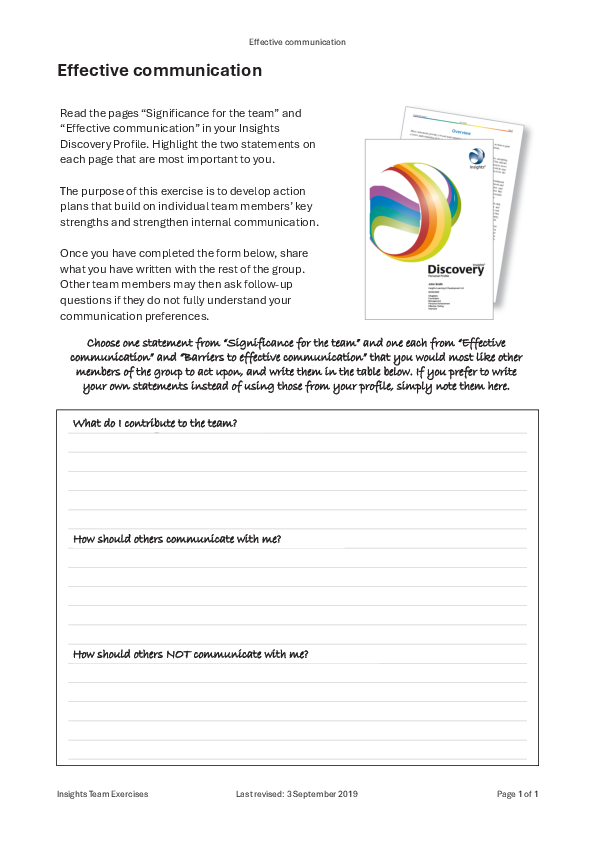
In this programme, personality profiles from Insights are used to form the groups. Insights operates with nine distinct personality types, and the groups are composed to be as heterogeneously as possible based on these profiles. The rationale is that after completing their education, students should be able to collaborate with anyone, regardless of their personal preferences. In heterogeneous groups, they encounter individuals who think differently, helping them become better at communicating with people who view the world from a different perspective.
The work begins with an exercise from Insights on effective communication and collaboration across the different personality types (see appendices 3-5). This takes about two hours in total. The groups consist of 7-8 members, reflecting the working conditions students are likely to face after completing their studies. New groups are formed every semester, also based on the personality tests.
Working with people who view the world differently can be challenging. As a result, in some cases, this leads to significant and more frequent conflicts compared to homogeneous groups.
Example 14
The students participate in three different randomly assigned study groups before the final study groups are formed. This allows the students to experiment with various collaborative dynamics and methods. The final study groups are created based on a conversation between the mentor team and the students regarding individual preferences, informed by experiences from earlier groups.
This happens in a one-on-one conversation between each student and a mentor, during which the students express their preferences for future groups using a points system. Three rotating groups are formed, followed by a final fixed group. The mentor team forms the groups. They set the framework – a task previously undertaken by the tutors. The mentor team consists of 10 people, each allocated five hours per week to manage the study group process throughout the year. It is assumed that the department head decided to assign this responsibility to the mentors. The groups remain fixed until the second semester, after which it is up to the students whether to stay in their respective groups or leave them. The mentors are responsible for ensuring that any arising issues are appropriately resolved throughout the semester. Overall, the students express great satisfaction with the groups, with 78.8% stating at the end of the autumn semester of 2021 that they made extensive use of their study groups.
The study group processes are combined with workshops that run parallel to the teaching. During these workshops, the mentors set the assignments for the groups.
Example 15
The student instructors form the groups. Each student instructor decides individually how they want to approach this. Some do it randomly, while others base it on a short questionnaire they create themselves. Some of the criteria included in these questionnaires have been preferences and expectations regarding, for example, working methods.
Example 16
Before the commencement of studies, the teacher, in collaboration with the private company UniHelper, designs an online questionnaire for the students. UniHelper works with three types of questions: 1-2 questions deemed important by the degree programme, 2 questions concerning the students’ expectations, and 24 questions aimed at assessing competences. The goal is to form homogeneous groups. The teaching team decides on the criteria for forming the study groups, which can include prior knowledge of the language, distribution of students from the same supplementary subject, gender, personality types, and comparable levels of ambition.
In the first semester, the students are informed about how the questionnaire serves as the basis for forming the study groups. It takes about 10-15 minutes to complete the questionnaire.
In the second semester, new groups are formed, allowing students to meet new people and develop their academic collaboration skills. New criteria are incorporated into the algorithm used by UniHelper, including the students’ grades. This ensures that groups have a roughly similar academic level, as experience shows that this leads to the best-functioning groups.
In the third semester, students are allowed to form their own groups. The only requirement is that all students must be part of a group. If this is not successful, the teachers will once again take charge of establishing the groups.
Read more at AU Educate: Questionnaire for creating study groups
Example 17: Research project at Aarhus BSS regarding the composition of study groups
At Aarhus BSS (Economics and Business Administration with a supplementary subject), a three-year research project (2022-2025) on the composition of study groups is being conducted. The project is based on a PhD project investigating the evidence for predicting student dropout rates based on the composition of study groups. The project builds on studies that indicate that grades from qualifying exams are significant predictors of dropout rates and that there should be a certain degree of heterogeneity within the groups. However, the differences should not be too pronounced. There should always be at least one other person in the group with whom each student can identify. Therefore, groups are composed partly based on grades. Additionally, consideration is given to personality traits that influence the students’ perseverance. The hypothesis is that perseverance is contagious, so it is essential to ensure that perseverance is represented in all groups. The goal is to collect enough data over three years to determine the optimal composition of study groups.
Participation in study groups is not mandatory. Only in one specific course are the groups required to collaborate on reading texts.
Regarding the composition of study groups, consider the following questions:
|
The fourth factor concerns how to approach the evaluation or assessment of the study groups’ work. Here, two main issues are at stake: The first is whether the assessment should focus on collaboration or on learning outcomes. The second concerns individual versus collective grading.
Regarding the focus of the assessment, Meijer et al. (2020) point out that although summative assessment strongly influences what students learn, formative assessment may be more conducive to collaboration and, consequently, also contribute to higher learning outcomes (ibid.: 1234-35).
With regard to the relationship between individual and collective grading, in Denmark grades must always be given on an individual basis, even in group exams. Formally, the challenge of individual versus collective assessment is resolved, but in practice, it may still be difficult to differentiate between each student’s performance. Meijer et al. (2020) highlight that the increasing use of group work in higher education poses challenges related to assessment. First, there is the question of how to ensure valid assessments of each student’s competences. Second, there is the risk that assessing the individual student’s academic level may undermine the very idea of group work. For example, focusing on personal grades may reduce the desire to share knowledge and assist one another, as well as weaken individual accountability and positive interdependence within the group, and some may become “free riders.” (See Le et al. 2020 for further elaboration on the distinction between individual and collective assessments, validity, etc.).
Example 18
Collaboration within each group is evaluated continuously (informally). As part of the semester project and practical component, students must submit both a group logbook (process report) and an individual logbook. These are also included in the oral exam, where students are asked about the content of the logbooks, such as how they handled crises within the group.
Example 19
As part of their semester projects, students are required to comment on the collaboration. Additionally, at the end of the project, they must reflect on their own experience within the groups and submit a half-page written reflection on it.
Regarding the evaluation/assessment of the study group’s work, consider the following questions:
|
The fifth factor relevant to study groups concerns the learning processes that actually take place within them. These depend on many different elements (Baker, 2015). Therefore, it is important to consider which learning processes are intended to take place within the groups.
In general, group work enables types of learning that differ from individual study. In addition to fostering collaboration skills, working in groups also allows for the development of disciplinary understanding at another level not achievable through individual work. It is relevant to distinguish between the forms of collaboration that the group assignments encourage. Baker (2015) distinguishes between co-operative and collaborative group work. In co-operative group work, the group can divide the assignment so that each member completes a separate part, whereas collaborative group work involves collaboration on ideas and understanding, leading to a shared development of knowledge and a joint understanding of the problem area:
[...] the most ‘collaborative’ situations are those that are largely exploratory, where no clear plan or procedure exists for solving the problem (or, indeed, for organising collaboration). In such situations, the aim will be for students to explore the problem space and in so doing gain deeper conceptual understanding. This is collaboration as “co-elaboration” of knowledge and understanding of the joint problem space[...] (Baker, 2015:455)
If the intention is for students to learn about collaboration, it is important to make the nature and process of collaboration explicit (see, for example, Le et al., 2018; Meijer et al., 2015; Järvenoja et al., 2015) and to make it a subject of evaluation in one form or another.
Regarding learning processes in study groups, consider the following questions:
|
The sixth factor is learning prerequisites. It is not possible to change the prerequisites that the students come with, but it is worth considering how to accommodate them and potentially influence them. Here, particular attention can be given to the framework of the study group and its work. In this way, expectations for what it means to study and how learning takes place in study groups can be adjusted early and clearly.
Consideration can also be given to the challenges involved in learning how to study. This can be done, for example, by supporting the groups in developing study strategies, organising group work, etc.
Regarding the students’ learning prerequisites, consider the following questions:
|
In addition, there are several commonly occurring problems in study groups. It is worth mentioning that problems and conflicts can be a source of development and learning, especially if they are addressed.
Le et al. (2016) examined which problems in group work are most prominent for both teachers and students, as well as the relationship between these problems. They identified four frequently occurring obstacles to effective collaboration:
The study concludes that a key cause of these problems in group work is a strong focus of the teachers on the cognitive aspects of collaboration and a weak focus on collaboration skills. If the teachers neither teach nor evaluate collaboration, it is likely that students will likewise focus on their individual academic learning and ignore the importance of collaboration.
Another study (Allan, 2016) examines students’ resistance to group work. Allan points out that students’ resistance often stems from a lack of clarity about what the group is expected to do. This lack of clarity leads to uncertainty and resistance among students. She distinguishes between co-operative and collaborative group work. In co-operative group work, the teacher is responsible for structuring the assignments and teaching the skills required so that each student learns everything necessary for completing the assignment. In contrast, in collaborative group work, each student aims to develop their individual contribution to the shared solution. These differences affect how the groups should be composed, the extent to which communication skills should be taught, the structure of the group, and the teacher’s role. Allan emphasises that regardless of which model is chosen, there will be frustration and resistance. Therefore, the goal is not to avoid these frustrations but to address them constructively. Above all, it is about being proactive and explicit regarding the purpose of group work, as students’ resistance primarily stems from their uncertainty about what they are supposed to do in the group.
This point is also seen in a smaller Danish study from the University of Copenhagen (Christensen et al., 2019), where students express a desire for teacher support in their group work, both regarding collaboration and the academic content. As one student put it:
No, well, of course the initiative should come from us, but when you start somewhere new, it would be great if the teacher started – like, ‘We’ll post these questions every week before the class, and it would be a really good idea if you could all met an hour before class or the day before class to go through it. You don’t need to discuss everything in detail, but just get an overview of it,’ or something like that […] So at least there’s some encouragement from the university. That way, we’re made aware of it, because even though we’re clever young university students, we’re starting somewhere new, there’s a lot going on, and so we might also be a bit slow on that point. Like, ‘oh, no one said we should. No, but then I guess it’s fine if I just do it on my own.’ (2 semester, pp. 7-8)
(Christensen et al., 2019: 8)
As a teacher, you are not trained to resolve collaboration issues in study groups, which can make it challenging to address such matters. Here are a few points from the research in this area, along with some research-based and relatively simple strategies that the teacher can employ.
Firstly, it is inevitable that problems and conflicts arise in collaborative relationships. It only becomes problematic if the group gets stuck in the conflict (Borg et al., 2011). For example, Tuckman (1965) described how groups typically develop through four stages: forming, norming, storming, and performing. In the forming stage, the group is established, and there will be a certain level of uncertainty until the purpose, etc., is clarified. Then comes the storming phase, where the group begins its work and conflicts and differing opinions about the nature of the assignment and solution. Next is the norming phase, where conflicts are resolved, and the focus shifts from individual to shared goals. The performing stage then follows, where the group collectively delivers the required outcomes. Finally, there is actually a fifth phase: adjourning, where the members may feel a bit sad as the group enters a "termination phase" – if the group is to be disbanded (A crash course in Danish in Tuckman’s theory of group development, PeopleTools.dk).
Secondly, conflicts can be valuable learning opportunities. Disagreement can introduce new perspectives that foster knowledge creation and innovation, whereas fundamentally shared understandings rarely lead to breakthroughs or learning (Hagedorn-Rasmussen, 2013:112). Within learning psychology, several types of learning are described. Cumulative learning is simple learning, such as memorising a PIN code. Assimilative learning, where existing knowledge is simply expanded, for example, by linking new concepts or theories to an existing understanding. And then there is accommodative learning, when you are confronted with something that does not fit your current understanding. This is where challenges arise, and it is particularly here that group processes create learning opportunities, as students encounter others’ perspectives and understandings (Hagedorn-Rasmussen, 2013). However, it requires a certain level of trust to be challenged in this way.
How to prevent conflicts: Research on group processes highlights the importance of being proactive (Borg et al., 2011). This can be done, for example, by:
How to address conflicts: When a conflict arises, the teacher can help the group move forward by asking questions to clarify what the disagreements are truly about. They may concern academic disagreements or uncertainties that simply require clarification from the teacher. Alternatively, just articulating the disagreements to an outsider may be enough for the group to move forward.
A more concrete approach is to go around the group, allowing each member to share their experience of the situation, followed by a dialogue (Petersen and Sørensen, 2019). The process could be as follows:
Another concrete approach is three-step active listening (Felder and Brent, 2001). This is particularly suitable in cases where the conflict appears to be entrenched. The teacher first listens to the parties on one side of the conflict and then to the parties on the other side, without interruptions from the opposing side. Next, the parties on both sides must articulate the other side’s viewpoints in a way that the opposing side can approve. Based on this, the students should be able to resolve the conflict themselves.
Materials that directly address students:
AU’s resource for students, AU Studypedia, has several suggestions on how groups can function effectively (Good collaboration) as well as some proposals on how to address conflicts: AU Studypedia: Good collaboration: Deal with conflicts
Additionally, Studenterrådgivningen (Student Counselling) has a website aimed at students, offering tips and tools on how to navigate and handle the challenges that come with studying: Studenterrådgivningen: Tips and tools. In Danish, they also have a website and an extensive booklet with advice on group work: Studenterrådgivningen: Gruppearbejde
Allan, E. (2016). I hate group work! In: InSight: A Journal of Scholarly Teaching. 2016, Vol. 11, p81-89. 9p.
Baker, Michael J. (2015). “Collaboration in Collaborative Learning.” Interaction studies 16.3 (2015): 451–473. Web.
Borg, M., Kembro, J., Holmén Notander, J., Petersson, C., & Ohlsson, L. (2011). Conflict management in student groups – a teacher’s perspective in higher education. Högre utbildning, 1(2), 111-124. https://lucris.lub.lu.se/ws/portalfiles/portal/5308517/2862084.pdf
Christensen, G., Andersen, P. Ø., & Jepsen, K. D. B. (2019). Anvendelse af studiegrupper. Københavns Universitet.
Danmarks Evalueringsinstitut (2022): Gruppearbejde på de videregående uddannelser. Førsteårsstuderendes oplevelser og erfaringer
Davidson, N., & Major, C. H. (2014). Boundary crossings: Cooperative learning, collaborative learning, and problem-based learning. Journal on excellence in college teaching, 25.
Felder, R. M., & Brent, R. (2001). Effective strategies for cooperative learning. Journal of Cooperation & Collaboration in College Teaching, 10(2), 69-75.
Fredricks, J. A., Blumenfeld, P. C., & Paris, A. H. (2004). School engagement: Potential of the concept, state of the evidence. Review of educational research, 74(1), 59-109.
Hagedorn-Rasmussen, Peter (2013): Konflikter som anledning til læring. I: Mac, Anita og Hagedorn-Rasmussen, Peter (red.) (2013). Projektarbejdets kompleksitet. Viden, værktøjer og læring. Samfundslitteratur
Hiim, H & Hippe, E. (2007). Læring gennem oplevelse, forståelse og handling. København: Gyldendalske boghandel
Isohätälä, J., Piia Näykki & Sanna Järvelä (2020): Cognitive and Socio-Emotional Interaction in Collaborative Learning: Exploring Fluctuations in Students’ Participation, Scandinavian Journal of Educational Research, 64:6, 831-851, DOI: 10.1080/00313831.2019.1623310
Järvenoja, H., Järvelä, S., & Malmberg, J. (2015). Understanding Regulated Learning in Situative and Contextual Frameworks. Educational Psychologist, 50(3), 204–219. https://doi.org/10.1080/00461520.2015.1075400
Johnson, D. W., Johnson, R. T., & Smith, K. A. (2014): Cooperative learning: Improving university instruction by basing practice on validated theory. Journal on Excellence in University Teaching, 25(4), 1-26.
Mac, Anita (2013): Projektgruppe og roller i projektgruppen. I: Mac, Anita og Hagedorn-Rasmussen, Peter (red.) (2013). Projektarbejdets kompleksitet. Viden, værktøjer og læring. Samfundslitteratur.
Meijer et al. (2020). Unfolding collaborative learning assessment literacy: a reflection on current assessment methods in higher education, Assessment & Evaluation in Higher Education, 45:8, 1222-1240, DOI: 10.1080/02602938.2020.1729696
Millis, B. J. (2014): Using cooperative structures to promote deep learning. Journal on Excellence in College Teaching, 25.
Petersen, Eva Bendix og Sørensen, Kasper Anton (2019): Projektgruppen – hvordan gør vi? Samfundslitteratur.
Pintrich, P. R. (2003). A Motivational Science Perspective on the Role of Student Motivation in Learning and Teaching Contexts. Journal of Educational Psychology, 95(4), 667–686. https://doi.org/10.1037/0022-0663.95.4.667
Thingholm, H. B., Reimer, D., Keiding, T. B., Due, J. L., & Smith, E. (2016). Navigating in Higher Education–NiHE.https://dpu.au.dk/fileadmin/edu/Udgivelser/E-boeger/Ebog_-_Navigating_in_Higher_Education_-_NiHE_-_2016_-_final.pdf
Zepke, N., & Leach, L. (2010). Improving student engagement: Ten proposals for action. Active learning in higher education, 11(3), 167-177.
Mac (2013) suggests using Belbin’s role theory by having group members use Belbin’s nine roles to identify which two or three roles they feel strongest in and which one or two they feel weakest in. The teacher can provide examples of how the different roles manifest themselves. If the group members know one another, the other participants in the group can contribute their perception of the person’s strengths and weaknesses in the role. This can form the basis for a dialogue about where the group is collectively strong or weak, and what the group might need to take into account as a result.
| Team role | Description of the role and contribution to teamwork | Allowable weaknesses that may accompany the role |
|---|---|---|
| Plant | Gifted, creative, and full of ideas. Tackles complex problems from new perspectives. | May be weak in their communication with others. Can be forgetful or lack practical sense. Sensitive to criticism. |
| Resource Investigator | Outgoing, enthusiastic, curious, and sociable. Explores opportunities and builds contacts. | Fickle. Can be easily bored and lose interest once initial enthusiasm fades. Talks too much. |
| Co-ordinator | Mature, confident, and trustworthy. Sets priorities, clarifies goals, and facilitates decision-making. Recognises and utilises others’ talents. | May be inclined to manipulate and can be a power seeker. Not necessarily the most knowledgeable in the team. |
| Shaper | Dynamic, highly driven, and restless. Challenges the team, thrives under pressure, and overcomes obstacles. | May have a fiery temperament. Can be impatient, argumentative, and stubborn. Sometimes provocative. |
| Monitor Evaluator | Analytical, level-headed, and objective. Makes sound judgements. Sees all the rational aspects of a situation. | May come across as overly blunt, critical, and sceptical. Can seem rather self-contained and uninspiring to others. |
| Teamworker | Socially oriented, outgoing, and perceptive. Sensitive, diplomatic, and flexible. Good listener. Avoids conflict and fosters a positive atmosphere. | May be indecisive or hesitant in difficult situations. Can be overly sensitive. |
| Implementer | Disciplined, reliable, and loyal. Efficient in turning ideas into action. Realistic and systematic. | Not very flexible. Tends to be slow to respond and adapt to change. |
| Completer Finisher | Thorough and conscientious. Seeks out errors and omissions. Strives for perfection, persistence, and precision. | Can worry excessively. Overconscientious and afraid of making mistakes. Reluctant to delegate. |
| Specialist | Contributes specialised knowledge and technical expertise. High level of professional commitment and self-confidence. Highly focused on goals and tasks. | Tends to isolate themselves and be uninterested in others. Protective of their own domain and contributes only within it. |
(Source: Translated from Potential.dk)
In the master’s programme in ...... we encourage and support students to work in study groups because ......
For example:
We know from experience that study groups help strengthen students’ academic and social connection to their peers and to the programme. Study groups enhance learning outcomes, improve the study environment, increase motivation for studies, and reduce dropout rates. Therefore, we encourage all students to actively participate in study groups and often recommend completing assignments within them. However, we must also emphasise that joining a study group is voluntary.
Below, you will find a description of how and when we form the study groups and follow up on them during the course of study, as well as whom to contact if any problems arise. At the beginning of each semester, you can find a description of the framework for study group work on the ...... page in Brightspace.
1 semester
At the beginning of the first semester, all students will have the opportunity to take part in a study group workshop together with their new study group, where the student guidance office offers advice and supports the group’s discussion on effective collaboration and mutual expectations.
How are study groups organised in the first semester?
For example:
When/how/who forms study groups?
For example:
Study group size:
For example:
When, how, and who follows up on the study groups during the semester (opportunity to join or change groups)?
For example:
Special conditions for exam groups:
For example:
The study group you are part of also functions as your examination group. According to the study regulations, there must be a minimum of ...... students in the group, who together will prepare a synopsis and go to the oral exam. If the group splits up, you must contact ......
Who should you contact with questions about study groups?
For example:
If you are unhappy in your study group, we recommend that you:
2 semester
3 semester
4 semester
For example:
Just because you are not writing about the same thesis topic doesn’t mean you can’t still be a study group! Did you have an amazing study group in the third semester? Then definitely hold on to it during your thesis process, which can otherwise be quite a lonely journey. Use the skills you’ve developed throughout your studies to plan study group meetings with an agenda and a facilitator. Identify and discuss shared themes and challenges you face, even if your thesis topics differ widely. Ask for and give feedback based on the methods you’ve practised during your studies. Support one another when things get tough and take a coffee break when needed.
1 The study is based on survey data from EVA’s longitudinal study on higher education and includes approximately 11,000 first-year students from all students offered a place through the Coordinated Enrolment System, meaning it is not limited to university students. The data were collected from first-year students in March 2020, i.e., students who had completed most of their first year before the COVID-19 lockdown (EVA, 2022).
